

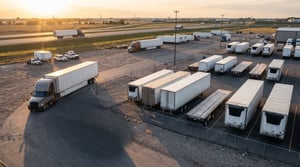
The Finloc Group provides an integrated ecosystem of financial and operational services for North American trucking companies through four specialized business units: Finloc 2000 Inc. (commercial equipment and trailer financing), vhub (smart trailer renting, repositioning, and digital interchange), FinPark (on-demand secure truck parking), and Fin4 Trucks & Trailers (pre-owned equipment sales). Backed by semi-trailer manufacturer Manac Inc., these services help fleet managers and operations leaders acquire rolling stock, monetize idle trailers, eliminate deadhead miles, and secure vetted parking across Canada and the United States. Rather than forcing carriers to juggle disconnected lenders, brokers, and yard operators, the group unites asset lifecycle management under one roof.
For operations directors and fleet managers, margin erosion rarely stems from a single catastrophic failure. Instead, profitability bleeds out through dozens of daily operational friction points: rigid bank loan covenants that ignore seasonal freight cycles, trailers sitting idle in regional yards while another terminal turns down freight, empty power-only repositioning runs burning diesel without revenue, and drivers losing precious Hours of Service (HOS) circling full truck stops.
Understanding how the Finloc Group’s four divisions interlock gives fleet leaders a blueprint for turning fixed overhead into agile, revenue-generating capacity.
| Business Unit | Core Function | Primary Operational Impact for Fleets |
| Finloc 2000 Inc. | Equipment Financing & Trailer Financing | Preserves working capital via tailored leases, loans, and sale-leasebacks aligned with real trailer depreciation. |
| vhub | Trailer Renting, Repositioning & Interchange | Generates passive income from idle trailers, cuts repositioning costs by up to 30%, and digitizes custody transfers. |
| FinPark | On-Demand Truck Parking Marketplace | Saves drivers roughly an hour per day searching for parking while reducing cargo theft and HOS violations. |
| Fin4 Trucks & Trailers | Used Equipment Sales & Remarketing | Delivers rapid fleet expansion or replacement from a 700+ unit North American inventory with integrated financing. |
How does the Finloc Group’s ecosystem support North American fleets?
Most commercial lenders view a tractor-trailer combination as a single generic collateral category, and most logistics software vendors solve only one narrow dispatch bottleneck. The Finloc Group approaches fleet management differently because of its corporate DNA. Operating as the financial and mobility services arm backed by Manac Inc.—a North American semi-trailer manufacturer with over 60 years of engineering experience and more than 200,000 trailers on the road—the group builds its financial underwriting and operational platforms around the real-world physics and economics of freight equipment.
When an organization understands how a dry van, refrigerated unit, or flatbed depreciates over a 10-to-15-year lifespan, how cross-border drop-and-hook networks stall when paperwork goes missing, and why cargo theft spikes in unguarded lots, its services reflect operational reality. Together, Finloc 2000 Inc., vhub, FinPark, and Fin4 Trucks & Trailers cover every stage of an asset's lifecycle:
- Acquisition: Sourcing new or pre-owned rolling stock and structuring debt or lease facilities around freight cash flow.
- Utilization: Deploying excess trailer capacity into the open market or sourcing short-term rentals during peak shipping surges.
- Protection & Compliance: Securing vetted, reservable parking along high-congestion freight corridors.
- Disposition & Remarketing: Offloading aging assets or converting existing fleet equity back into liquid working capital.
What financing solutions does Finloc 2000 Inc. provide for freight equipment?
Finloc 2000 Inc. serves as the financial engine of the group, specializing in Freight Equipment Financing, Equipment Financing, and Trailer Financing across Canada and the United States. Having financed commercial transport assets since 1999 with a team averaging over 45 years of heavy equipment finance expertise, the firm structures capital around how trucking companies actually earn revenue.
Traditional commercial banks frequently misprice semi-trailer residuals because they lump trailers in with power units. A Class 8 tractor undergoes heavy mechanical wear and rapid early depreciation, whereas a well-maintained dry van or flatbed retains structural utility and residual value over a much longer horizon. Because Finloc 2000 Inc. understands exact trailer residual curves—including specialized variables like reefer cooling-unit engine hours—it offers lower monthly payments and flexible end-of-term exit paths that generalist lenders rarely match.
Why do lease structures matter for fleet balance sheets?
Fleet managers and CFOs rarely share identical goals for every asset class in the yard. Depending on whether you cycle equipment every four years to minimize maintenance or run trailers for over a decade, Finloc 2000 Inc. offers distinct financial structures:
- Split-TRAC Leases: A Terminal Rental Adjustment Clause (TRAC) lease establishes a predetermined residual value at contract signing. Unlike standard TRAC leases where the carrier absorbs 100% of market-value shortfalls at term end, a Split-TRAC lease divides residual risk between the fleet and Finloc. This lowers monthly cash outflow while capping end-of-term exposure.
- Fair Market Value (FMV) Leases: Designed for fleets that operate on strict replacement cycles and want to keep equipment off their balance sheet, FMV leases deliver the lowest monthly payments. At lease maturity, operations leaders can return the trailer, renew the contract, or purchase the unit at its prevailing market price.
- Capital Leases and Equipment Loans: Built for carriers that plan to operate dry vans, specialized flatbeds, or vocational trucks for 10+ years. Ownership rests with the carrier from day one (loans) or transfers via a nominal buyout at term end (capital leases), preserving depreciation tax benefits while building long-term equity.
- Sale-Leasebacks: When freight rates tighten or expansion opportunities arise, fleets sitting on paid-off rolling stock can sell those assets to Finloc 2000 Inc. and immediately lease them back. This unlocks trapped equity into immediate working capital without pulling a single trailer out of service.
- Lease Lines of Credit & Project Financing: Growing carriers acquiring multiple units across a fiscal year can establish a pre-approved lease line of credit, drawing funds as manufacturers deliver equipment without repeating full underwriting for every serial number.
Speed is equally critical in freight operations. When a time-sensitive contract requires immediate capacity, waiting three weeks for a bank credit committee means losing the lane. Finloc 2000 Inc. processes online credit applications with decisions typically delivered within a few hours for transactions under $250,000, and within 24 hours for larger fleet facilities. Payment schedules can also incorporate seasonal skips ("payment vacations") or step-up/step-down structures tailored to agricultural, construction, or retail freight cycles.
How does vhub transform trailer renting, repositioning, and interchange?
Acquiring equipment is only half the battle; keeping those assets loaded and moving is what drives return on invested capital. vhub is the Finloc Group’s digital smart trailer-sharing platform designed to eliminate two of the most expensive inefficiencies in North American trucking: idle yard inventory and empty deadhead miles.
According to operational benchmarks from the American Transportation Research Institute (ATRI), empty or deadhead miles consistently account for roughly 15% to 20% of total fleet mileage across the trucking sector—burning fuel, accumulating tire and brake wear, and consuming driver hours while generating zero revenue. vhub attacks this inefficiency through three integrated operational modules: vhub Rental, vhub Repositioning, and vhub Interchange.
How can fleets monetize idle capacity with vhub Rental?
Every fleet experiences regional imbalances and seasonal troughs. A carrier might have 30 dry vans sitting against a fence in Columbus or Dallas during a slow quarter while a regional peer scrambles to cover a surge contract ten miles away.
Through vhub Rental, asset owners list idle trailers on a centralized North American marketplace at zero upfront posting cost. Fleet managers seeking short-term or extended Trailer Renting can filter available units by location, door type (swing or roll), trailer category, and route via desktop or mobile app. Digital contracting, insurance verification, and automated billing replace legacy phone tag and faxed agreements, allowing carriers to scale capacity up or down without committing to multi-year leases.
How does vhub Repositioning cut empty trailer relocation costs?
Traditionally, when a drop-and-hook network becomes unbalanced, operations teams have to dispatch a power-only tractor to haul an empty trailer hundreds of miles back to a high-demand terminal. That pure expense hits the P&L immediately.
vhub Repositioning flips this dynamic into a "load-out" marketplace. A fleet with an empty trailer in City A that needs to reach City B posts the relocation need on vhub. A carrier or owner-operator already heading along that corridor rents the trailer, hauls a paying freight load to City B, and drops the unit at the designated destination. By matching empty equipment with outbound freight, fleets reduce trailer repositioning expenses by up to 30% while helping partner carriers eliminate deadhead miles.
What makes vhub Interchange safer than paper trailer transfers?
Drop-trailer operations and cross-border handoffs frequently break down at the point of custody transfer. Carbon-copy inspection forms get lost, pre-existing roof or tire damage goes undocumented, and disputes over per-diem billing drag out for months.
vhub Interchange replaces manual paperwork with a fully auditable digital chain of custody:
- AI-Assisted Digital Inspections: Drivers or yard staff capture standardized photos and video at check-in and check-out. Automated visual comparison tools flag new dents, structural damage, or tire discrepancies against the pre-rental baseline.
- GPS Custody Logging: Every handoff between carriers, shippers, and cross-border partners is timestamped and geotagged, giving operations leaders real-time visibility into who holds physical and financial responsibility for every trailer.
- Automated Invoicing & Claim Resolution: Built-in billing and dispute workflows attach timestamped inspection evidence directly to invoices, accelerating claim settlements and eliminating administrative friction.
How does FinPark solve the commercial truck parking shortage?
For operations leaders, Truck Parking is no longer just a driver convenience issue—it is a direct threat to fleet safety, Hours of Service (HOS) compliance, and cargo security. Research from the American Transportation Research Institute (ATRI) and the U.S. Department of Transportation (DOT) consistently ranks truck parking among the top concerns for commercial drivers, showing that drivers lose an average of 56 minutes of available drive time every day searching for safe, legal parking. Across a year, that wasted search time strips away thousands of revenue-generating miles per truck while forcing drivers to either shut down early—sacrificing productivity—or risk parking on unlit highway ramps and shoulders.
FinPark addresses this bottleneck as a cloud-based, on-demand truck and trailer parking marketplace operating across Canada and the United States. Rather than leaving drivers to gamble on full public rest areas at 8:00 PM, FinPark connects dispatchers and drivers with a vetted network of secure, reservable yards.
What operational advantages does FinPark offer dispatchers and drivers?
- Guaranteed Advance Reservations: Using the FinPark web portal or mobile app, fleet dispatchers can pre-book hourly, overnight, or monthly spaces directly along a driver's planned route before the load even departs. Drivers using FinPark save an average of one hour per day, preserving HOS clocks and improving on-time delivery reliability.
- Vetted Security & Cargo Protection: Unsecured roadside parking exposes high-value freight to cargo theft and trailer break-ins. FinPark’s risk management team vets participating yards and displays transparent listings detailing fencing, lighting, camera surveillance, gate access, and on-site amenities before booking.
- Paperless Fleet Billing: Instead of reconciling dozens of out-of-pocket driver receipts and cash reimbursements, fleets manage reservations and automated digital payments through a centralized account.
- Yard Monetization for Carriers: Trucking companies that own underutilized terminal space can also list excess spots on FinPark’s browser dashboard—turning surplus yard real estate into a steady ancillary revenue stream while FinPark handles insurance verification, booking management, and customer support.
What role does Fin4 Trucks & Trailers play in used equipment sales?
When new OEM build slots carry long lead times or capital budgets demand lower acquisition costs per unit, pre-owned rolling stock becomes essential to fleet strategy. Fin4 Trucks & Trailers is the Finloc Group’s dedicated Used Equipment Sales and remarketing division, maintaining a North American inventory of more than 700 pre-owned assets.
Operating across major trucking hubs in Canada and the United States, Fin4 supplies dry vans, refrigerated trailers, flatbeds, dump trailers, and commercial tractors across multiple makes and models. What distinguishes Fin4 from fragmented regional used-truck lots is how tightly its sales workflow integrates with the rest of the Finloc ecosystem:
- Flexible Condition Tiers ("Certified" vs. "As-Is"): Operations teams with robust in-house maintenance shops can purchase budget-friendly As-Is units for rapid deployment. Fleets seeking immediate road-ready reliability and DOT/CVSA compliance can select Certified units that have undergone comprehensive mechanical inspection and servicing.
- Turnkey Financing via Finloc 2000 Inc.: Buyers do not have to secure external bank approval before locking down inventory. Fin4 specialists coordinate directly with Finloc 2000 Inc. to bundle the equipment purchase and tailored lease or loan structure into a single transaction.
How can fleet managers deploy the Finloc Group ecosystem together?
The true competitive advantage of the Finloc Group emerges when operations leaders combine these four divisions into a unified operating model rather than treating them as standalone vendors.
Consider a mid-sized regional carrier winning a new 18-month dedicated retail contract requiring 25 additional dry vans and staging capacity near a congested metropolitan distribution center:
- Step 1 – Rapid Acquisition: Instead of tying up cash reserves, the fleet sources 15 certified late-model dry vans through Fin4 Trucks & Trailers and finances them using a flexible Split-TRAC lease from Finloc 2000 Inc. with approvals finalized in 24 hours.
- Step 2 – Agile Surge Capacity: To cover the remaining 10 trailers needed only during peak Q3–Q4 shipping months, the operations manager books short-term units through vhub Rental, avoiding year-round lease payments on seasonal equipment.
- Step 3 – Frictionless Drop-and-Hook: As trailers cycle between the carrier’s tractors and third-party drayage partners at the distribution center, vhub Interchange logs GPS custody transfers and AI photo inspections automatically.
- Step 4 – Secure Staging & Rest: Dispatchers reserve dedicated overnight and staging slots near the metro hub via FinPark, ensuring drivers never burn HOS hours hunting for legal parking or leave high-value retail freight exposed on highway shoulders.
By aligning equipment finance, dynamic trailer sharing, secure parking infrastructure, and pre-owned remarketing under one roof, the Finloc Group equips trucking leaders to protect operating margins, maximize asset utilization, and scale sustainably across North America.
Frequently Asked Questions
1. What services does the Finloc Group offer to trucking companies?
The Finloc Group offers an integrated suite of four services for North American carriers: equipment and trailer financing through Finloc 2000 Inc., smart trailer renting, repositioning, and digital interchange via vhub, on-demand secure truck parking through FinPark, and pre-owned truck and trailer sales via Fin4 Trucks & Trailers.
2. How fast can fleets get approved for trailer financing with Finloc 2000 Inc.?
Finloc 2000 Inc. typically delivers credit decisions within a few hours for equipment financing requests under $250,000 and within 24 hours for larger fleet facilities. Fleets can choose from Split-TRAC leases, Fair Market Value (FMV) leases, capital leases, equipment loans, and sale-leasebacks.
3. How does vhub reduce empty trailer repositioning costs?
vhub connects fleets that need to relocate empty trailers with carriers hauling paying loads along the same route. Instead of paying for empty power-only moves, fleets use vhub Repositioning to match trailers with outbound freight, reducing relocation costs by up to 30% while eliminating deadhead miles.
4. Where is FinPark truck parking available and how does it work?
FinPark operates an on-demand truck and trailer parking marketplace across Canada and the United States. Dispatchers and drivers use the mobile app or web portal to locate vetted yards by route, check security features, and reserve hourly, overnight, or monthly spots with automated paperless billing.
5. Can trucking companies finance used equipment purchased from Fin4 Trucks & Trailers?
Yes. Fin4 Trucks & Trailers maintains an inventory of over 700 pre-owned dry vans, reefers, flatbeds, and trucks across North America and partners directly with Finloc 2000 Inc. to provide integrated, customized financing.