

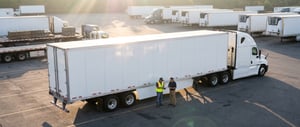
An owner-operator can secure trailer financing with limited credit history by working with specialized, asset-based commercial lenders rather than conventional depository banks. Because commercial trailers represent tangible, revenue-generating collateral with strong resale liquidity, specialized lenders evaluate operational viability, down payment equity, and carrier contracts instead of relying solely on an established credit score. Partnering with asset-based funding specialists like Finloc 2000 Inc. provides owner-operators and carrier fleet managers with flexible capital structures—such as customized equipment loans, TRAC leases, and structured down payments—that allow emerging operations to build credit and expand freight capacity simultaneously.
Why Is Trailer Financing So Difficult with Limited Credit?
For fleet managers and transportation executives, maintaining equipment availability across an owner-operator network is critical to service commitments. Yet, when prospective or newly leased-on owner-operators attempt to secure trailing assets through traditional commercial banks, they hit severe underwriting roadblocks.
Traditional financial institutions rely heavily on automated credit scoring algorithms and established business history metrics. When evaluating an application, traditional underwriters typically require:
- A minimum of two years of operational business history under an active USDOT/MC or Canadian authority.
- A clean corporate credit file with major commercial reporting bureaus (such as Dun & Bradstreet, Experian Commercial, or Equifax Commercial).
- Established business bank lines and audited financial balance sheets.
- A prime personal FICO score, generally above 680–700.
Emerging independent contractors rarely possess this corporate paper trail. Many have spent years hauling freight as company drivers before transitioning to independent contracting. Although they hold clean Commercial Driver’s Licenses (CDLs), immaculate safety records, and seasoned highway experience, conventional financial algorithms treat their lack of commercial credit as a default risk.
Furthermore, traditional underwriting fails to account for freight economics. When evaluating risk, depository institutions often weigh personal consumer liabilities without recognizing that a 53-foot dry van or temperature-controlled refrigerated trailer directly produces the operational cash flow needed to service its underlying debt.
How Does Asset-Based Equipment Financing Solve the Credit Gap?
When balance-sheet and credit history metrics fall short of institutional thresholds, Freight Equipment Financing shifts the underwriting lens from historical credit profiles to asset liquidity and earnings capacity.
Asset-based lenders underwrite the collateral itself. In commercial freight, trailing assets hold distinct structural advantages over vocational power units (Class 8 tractors):
| Evaluation Metric | Class 8 Power Units (Tractors) | Freight Trailers (Dry Van, Reefer, Flatbed) |
| Depreciation Curve | Rapid (sensitive to engine hours, overhaul cycles, emissions components) | Moderate, predictable, and slow |
| Maintenance Burden | High (complex powertrain, after-treatment systems, mechanical wear) | Lower (brakes, tires, structural integrity, refrigeration units) |
| Secondary Market Liquidity | Volatile, tied to engine reliability and emissions regulations | High universal demand across regional and cross-border fleets |
| Residual Value Retention | Varies widely based on mileage and service history | Strong, steady retention across standard 5-to-10 year operational horizons |
Because trailers hold intrinsic value and carry predictable depreciation profiles, specialized lenders like Finloc 2000 Inc. can mitigate limited credit profiles by structuring transactions directly against the collateral value. Rather than issuing an immediate decline, asset-focused underwriters look at the driver's industry tenure, lane stability, and down payment capacity.
What Types of Trailer Financing and Trailer Leasing Are Available?
Fleet operations leaders and owner-operators must identify the financing structure that best balances balance-sheet leverage, tax strategy, and monthly cash flow.
1. Equipment Finance Agreements (EFA) and Secured Loans
Under an Equipment Finance Agreement or conventional commercial loan, the owner-operator borrows capital to purchase the trailer directly, taking immediate title upon closing. The financing company retains a security interest (a first-priority lien) on the vehicle title until the amortization schedule finishes.
- Best For: Operators focused on long-term equity accumulation and capturing Section 179 depreciation tax write-offs.
- Credit Considerations: Requires higher down payments (typically 15% to 25%) when credit history is unseasoned.
2. Capital Leases ($1 Buyout Lease / Finance Lease)
A capital lease operates similarly to a loan while technically structuring the arrangement as a lease agreement. The owner-operator treats the trailer as an operational asset on their balance sheet, claiming depreciation deductions. At the end of the term, the operator acquires full title by paying a pre-determined nominal fee (often $1.00).
- Best For: Contractors wanting the path to outright ownership while enjoying flexible lease documentation.
- Credit Considerations: Flexible underwriting thresholds; asset equity provides primary loan security.
3. Terminal Rental Adjustment Clause (TRAC) Leases
The TRAC lease is one of the most widely utilized structures in commercial transportation. It combines low monthly cash outflows with structured residual risk. At inception, the lender and lessee establish a pre-determined residual value (for example, 20% of original invoice value at month 48).
At the end of the lease term, the operator has three distinct options:
- Purchase the trailer for the agreed TRAC value.
- Refinance the remaining TRAC balance into a secondary loan.
- Return the trailer to be sold on the commercial secondary market. If the net sale price exceeds the TRAC value, the operator keeps the equity surplus; if it sells for less, the operator pays the difference.
- Best For: Fleet operations wanting to minimize monthly overhead and preserve liquidity for working capital.
- Credit Considerations: Highly viable for newer operators because lower monthly payments reduce debt-service coverage ratio (DSCR) pressure.
4. Fair Market Value (FMV) and Operating Leases
Operating Trailer Leasing allows companies and independent contractors to operate modern trailing equipment without assuming long-term residual value risk. Payments are treated as operational operating expenses (OpEx), keeping the debt off the balance sheet while lowering taxable net income.
- Best For: Managing peak freight volumes, taking on dedicated cyclical contracts, or running low-maintenance late-model reefers.
- Credit Considerations: Readily accessible through specialized lease platforms when backed by a strong carrier sponsorship or corporate lease-on program.
How Does Finloc 2000 Inc. Support Transportation Equipment Acquisition?
Commercial trucking requires financial partners who comprehend freight volatility, regulatory shifts, and capital maintenance requirements. Finloc 2000 Inc. brings more than 40 years of dedicated experience to commercial transport and heavy equipment financing.
Instead of using generic underwriting algorithms, Finloc 2000 Inc. approaches capital delivery through industry-specific asset evaluation:
- Rapid Credit Decisions: Decisions on standard equipment requests are often delivered within hours, keeping fleet managers and drivers from losing out on available secondary-market inventory.
- Tailored Repayment Architectures: Cash flow in trucking is rarely flat across twelve consecutive months. Finloc 2000 Inc. structures seasonal payment accommodations, skip payments during seasonal volume shifts, and step-up or step-down amortization schedules that match freight lane cycles.
- Diverse Asset Support: Financing spans the complete spectrum of trailing assets, including dry van trailers, refrigerated units (reefers), flatbeds, step decks, drop decks, chassis, and heavy-haul pneumatic bulk tankers.
- Cross-Border Expertise: Specialized funding coverage supports equipment acquisitions across both Canadian and U.S. freight corridors, assisting carriers running interstate and cross-border lanes.
By prioritizing real-world fleet utilization over abstract bureau scores, dedicated transportation financiers help carriers turn qualified drivers into equipped, profitable owner-operators.
What Key Steps Should an Operator Take to Secure Approval?
For an owner-operator with a thin credit profile, thorough preparation can bridge the gap between underwriting rejection and competitive approval terms. Operations leaders can guide their drivers through the following systematic process:
Step 1: Accumulate Sufficient Upfront Equity (Down Payment)
In asset-based lending, down payment capital is the ultimate mitigating factor. A borrower with established corporate credit might secure zero-down financing, but an operator with limited credit history should expect to contribute 10% to 25% down. This initial equity cushion shields the lender against early repossession losses and reduces the borrower’s monthly payment burden.
Step 2: Assemble Complete Verification Records
Lenders underwriting thin credit files look closely at cash flow velocity and driver qualifications. Before submitting an application, compile a complete documentation packet:
- Commercial Operating Proof: Valid CDL Class A, medical card, and verifiable driving history (Motor Vehicle Record - MVR).
- Banking Verification: 3 to 6 months of complete business or personal bank statements proving positive average daily balances and an absence of non-sufficient fund (NSF) charges.
- Carrier Lease Agreement: If leased onto a prime carrier, a copy of the Independent Contractor Agreement, carrier pay history, and direct deposit settlements.
- Independent Authority Documentation: For operators with their own authority, provide your active MC/USDOT registration, proof of commercial liability insurance, and references for primary freight brokers or direct shipper accounts.
Step 3: Choose Equipment with Prudent Secondary Market Liquidity
When credit history is light, selecting the right equipment is critical. Financing an aged, highly customized trailer with obsolete specifications represents a high risk for the funder. If the operator defaults, custom equipment is costly to liquidate.
Underwriters favor late-model, mainstream equipment from tier-one manufacturers (e.g., Great Dane, Utility, Wabash, Hyundai Translead, Vanguard). Standard 53-foot air-ride dry vans or reefers equipped with verified Thermo King or Carrier units retain high liquidation value, making credit approval significantly easier.
What Are Alternative Capital Strategies If Direct Approval Fails?
If a solitary credit application cannot meet baseline underwriting thresholds, fleet managers and independent contractors can utilize several alternative operational structures:
- Carrier Lease-Purchase Partnerships: Many mid-size to large fleets operate internal equipment programs. The carrier secures the trailer fleet using corporate credit lines or institutional fleet master leases, then sub-leases the equipment to independent owner-operators with payments deducted from weekly settlements.
- Qualified Personal Co-Signers: Adding an established business partner or a family member with strong personal credit (700+ FICO) to the commercial loan guarantee provides the missing financial covenant required by credit committees.
- Pledging Additional Free-and-Clear Collateral: If the driver owns their Class 8 tractor or other commercial equipment outright without liens, pledging that title as cross-collateral can offset a thin credit profile.
- Vendor & Dealer Floor Plan Partnerships: Working directly with authorized equipment dealerships that partner with dedicated asset-based lenders ensures applications are routed to lenders who understand commercial salvage and secondary values.
How Can Fleets and Owner-Operators Maximize Long-Term Return on Investment?
Acquiring a trailer is an ongoing capital management discipline. Once financing or leasing is executed, operators must manage operational variables to protect their cash flow and build an unassailable commercial credit profile:
Proactive Preventive Maintenance
A trailer sitting in a repair bay because of blown wheel seals, damaged landing gear, or a failed refrigeration unit generates zero revenue while its monthly debt service remains due. Operators must budget $0.08 to $0.15 per loaded mile into a dedicated maintenance escrow account.
Timely Commercial Debt Reporting
Ensure your lender reports ongoing payment history to major commercial credit bureaus. Making complete, on-time payments over a 12-to-24-month horizon turns an operator with "limited credit" into a prime commercial borrower, paving the way for lower interest rates and reduced down payment requirements on subsequent power units and trailers.