

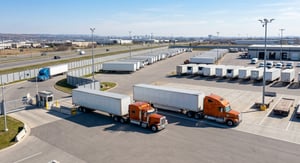
For operations leaders and fleet managers running small to mid-sized trucking operations, managing an over-the-road (OTR) fleet across state lines can feel like a high-stakes chess match where the rules change every 50 miles. Every state line crossed introduces new variables, strict local enforcement, and a recurring, stress-inducing question: Where is my asset going to park safely tonight?
When your drivers are running tight regional or cross-country schedules, asset visibility and driver compliance are non-negotiable. Yet, the systemic shortage of parking spaces turns everyday route planning into an operational gamble. Dispatchers lose time scrambling to map out overnight stops, drivers burn valuable Hours of Service (HOS) searching for a legal spot, and high-value cargo sits exposed in unmonitored lots.
For a scaling fleet, this isn’t just a daily annoyance; it’s a direct drain on your bottom line. To remain competitive against mega-carriers, small and mid-sized fleets need an infrastructure that delivers on-demand flexibility. That’s where FinPark steps in.
By building a robust, cloud-based infrastructure specifically designed for fleet management, FinPark transforms truck and trailer parking from a chaotic daily variable into a predictable, scalable asset. Here is how expanding fleets are leveraging FinPark's truck parking networks to protect assets, supercharge drop-and-hook operations, and slash costly terminal delays.
The True Cost of the Parking Crunch for Growing Fleets
The national truck parking crisis isn’t news to anyone working in logistics. However, the true operational and financial impact on small to mid-sized carriers is frequently underestimated. According to data from the American Trucking Associations (ATA) and the Federal Highway Administration (FHWA), there is only one parking space available for every 11 truck drivers on the road.
For a carrier with 20, 50, or 150 trucks, that mathematical imbalance translates directly into lost margin.
HOS Drain and Driver Fatigue
When a driver is forced to shut down early simply because they stumbled upon a rare open slot, or conversely, if they blow past their safe driving limit searching for a space, your business suffers. Drivers lose an average of 56 minutes of driving time per day looking for a place to park. Multiply that hour across a multi-state fleet over an entire year, and you are looking at tens of thousands of dollars in wasted fuel, unbilled capacity, and unnecessary emissions per tractor.
Safety Risks and Cargo Theft
Unsecured parking isn’t just an administrative hazard; it's a security nightmare. Parking on highway exit ramps, vacant industrial shoulders, or poorly lit, unmonitored drop yards exposes your drivers to dangerous working conditions and exposes your clients' freight to cargo theft syndicates. For mid-sized fleets, a single cargo claim or insurance premium hike caused by theft from an unverified lot can wipe out a month's worth of profitable lanes.
Operational Fragmentation
Many fleet managers attempt to solve this problem ad-hoc. Dispatchers maintain fragmented internal spreadsheets of "known good lots," call yard operators individually to check space, or force drivers to pay out of pocket at premium commercial stops and submit paper receipts. This localized approach shatters visibility. When assets cross multiple states, management loses track of real-time yard conditions, local security parameters, and aggregate spending.
FinPark: Your Centralized Multi-State Fleet Solution
FinPark completely bypasses the traditional, broken approach to over-the-road parking. Operating as a unified, cloud-based marketplace across the United States and Canada, FinPark connects fleets directly with verified, secure truck parking facilities via an intuitive web platform and mobile app.
Instead of managing dozens of individual relationships with localized yards, fleet operations leaders use FinPark as a single point of truth. Whether your lanes run from Laredo up through the Midwest, or cover dense freight corridors across the Northeast, FinPark consolidates available real-time capacity into an accessible dashboard.
The platform normalizes everything a carrier needs to know before booking:
- Live Space Availability: Instant access to open inventory, eliminating the risk of arriving at an overbooked facility.
- Verified Site Security: Every yard in the network undergoes structural screening by FinPark's dedicated risk management team.
- Comprehensive Facility Details: Clear profiles highlighting fencing, lighting, automated entry systems, and driver amenities (such as showers, Wi-Fi, and lounge areas).
By digitizing this fragmented real-world footprint, FinPark offers small and mid-sized fleets the administrative clout and geographic reach of a national carrier without the massive capital expenditure of building private terminals.
1. Ironclad Asset Protection: Advanced Secure Truck Parking
When your equipment leaves your primary terminal, you shouldn't have to cross your fingers and hope it returns intact. Cargo theft and trailer break-ins have risen sharply across major freight hubs, targeting high-value goods and unmonitored equipment.
FinPark protects your mobile capital by ensuring that secure truck parking isn't a premium luxury—it’s the baseline standard. Every facility listed on the platform is vetted to verify its security claims.
What Clean, Secure Parking Means in the FinPark Network:
- Perimeter Integrity: Fully fenced, structurally sound perimeters that restrict unauthorized pedestrian or vehicle access.
- Active Surveillance: High-definition CCTV camera networks covering both tractor lanes and dedicated trailer storage sections.
- Monitored Access Control: Controlled entry points utilizing electronic pin codes, digital QR passes, or on-site security personnel to track exactly who enters and leaves the facility.
- Risk-Team Audits: FinPark's in-house risk management teams continuously monitor yard compliance, ensuring security equipment is operational and gate logs are maintained.
Providing access to verified locations builds a protective layer around your drivers, tractors, and cargo. When an operator pulls into a FinPark facility, they can confidently enter their off-duty rest period knowing their surroundings are safe. This peace of mind boosts driver morale, reduces insurance liability claims, and shields your business from the logistical nightmares of freight replacement and equipment repair.
2. Unlocking Asset Velocity: Optimizing Drop-and-Hook Operations
For modern carriers looking to maximize their fleet efficiency, the traditional live-loading model is increasingly being replaced by agile drop-and-hook operations. Dropping a pre-loaded trailer and immediately hooking up to another keeps your tractors moving and your revenue climbing. However, executing this model across multiple states requires highly coordinated regional drop pockets.
If your fleet lacks dedicated physical terminals in target regions, your drop-and-hook strategy can quickly break down. Drivers waste hours looking for staging locations, or worse, trailers are dropped in unauthorized, unmonitored commercial zones where they risk being towed, impounded, or looted.
FinPark solves this structural bottleneck by providing flexible, on-demand trailer parking nodes exactly where your lanes demand them.
Seamless Regional Relay Operations
With FinPark, fleet managers can establish reliable, virtual relay stations across major multi-state corridors. Your long-haul drivers can drop loaded trailers at a secure network facility near a major metro market, allowing a local or short-haul driver to finish the final mile delivery. This setup keeps your OTR drivers operating within clean, predictable geographic loops without exceeding their HOS limitations.
Flexible Staging for Volatile Shippers
Shippers are notoriously unpredictable. If a manufacturing plant or distribution center delays an appointment slot, or lacks yard space to store your empty equipment, you can use FinPark to instantly book nearby short-term or long-term truck parking. This flexible capacity buffer allows you to store staging equipment safely without relying on the shipper's crowded property.
Instant Digital Visibility
Instead of relying on drivers to text yard locations or trailer numbers, dispatchers can track and manage reservation locations right from the central FinPark dashboard. You'll know exactly which facility holds your empty chassis, dry vans, or reefers, making it easy to schedule your next hook-and-go assignment.
3. Eradicating the Profit Killer: Detention Time Reduction
In a tight freight market, profit margins are won or lost on asset utilization. There is no greater threat to asset utilization than detention time. When a driver is trapped at a shipper's dock waiting for cargo to clear, or delayed because a nearby receiver lacks staging space, your entire operational schedule ripples with delays.
The downstream damage of detention time is a logistical domino effect:
FinPark plays a crucial role in detention time reduction by detaching your driver's rest and compliance schedule from the volatile timelines of shipping docks.
Advanced Booking vs. Emergency Scrambling
When a dispatcher notices a delay unfolding at a customer facility, they don't have to wait for the driver to run out of hours to find a solution. Using FinPark’s real-time truck parking networks, the back office can book an advanced reservation at a secure site right along the driver's route. The driver can pull away from a dysfunctional loading dock, head straight to a guaranteed spot, and immediately begin their regulatory rest break.
Eliminating the "Gate Shuffle"
At traditional truck stops, drivers often lose hours doing the "gate shuffle"—pulling into a crowded lot, finding it full, backing out into traffic, and driving to the next exit. FinPark’s streamlined booking platform cuts out this guesswork entirely. By equipping your team with predictable, guaranteed parking slots, your drivers preserve their legal driving windows for moving freight, not hunting for spaces.
4. Scalable Infrastructure: Flexible Short-Term and Long-Term Truck Parking
The parking needs of a growing fleet are rarely uniform. A carrier might need five spaces near the Port of Savannah for two nights to handle an import surge, while simultaneously needing three semi-permanent slots outside of Chicago for seasonal asset storage.
A rigid, long-term real estate lease ties up precious working capital and limits your ability to pivot when shipper contracts change. FinPark gives your operations the agility to scale up or scale down your regional footprint dynamically.
|
Parking Type |
Operational Use Case |
FinPark Advantage |
|
Short-Term Parking |
Overnight HOS breaks, staging for early morning delivery windows, emergency weather shutdowns. |
On-demand app booking, real-time geographic routing, instant automated payments. |
|
Long-Term Truck Parking |
Fleet asset staging, seasonal equipment storage, regular regional relay drops, weekend asset resets. |
Predictable monthly terms, guaranteed yard space, vetted security standards. |
By supporting both transient overnight stays and monthly long-term truck parking, FinPark allows small and mid-sized carriers to adjust their infrastructure costs in real-time. If you win a new shipper contract in an unfamiliar territory, you don't need to commit to expensive local real estate leases. You can instantly establish an operational footprint by securing dedicated lanes within the existing FinPark network, matching your overhead costs directly to active revenue streams.
Step-by-Step: How FinPark Streamlines Fleet Operations
Integrating a new tool into your dispatch routine shouldn't require weeks of intensive software training or heavy IT resources. FinPark is built for fast-paced logistics environments, allowing dispatchers and drivers to collaborate seamlessly with just three simple steps:
1.Search and Filter by Route:
Log into the FinPark web portal or open the mobile app. Input your target destination or active freight lane. Filter available locations based on required equipment classes (such as OTR tractor-trailers, trailer-only storage, or ocean containers) and key site features like automated gates or 24/7 security monitoring.
2.Select Duration and Book Securely:
Choose the exact reservation window your schedule requires—whether it's an hourly rest stop, an overnight layover, or a monthly long-term placement. Review the transparent, up-front pricing and complete the booking through an automated, paperless transaction. Your space is instantly locked in.
3.Route, Arrive, and Park Seamlessly:
The digital reservation, along with specific yard entry details, digital gate access codes, and navigation inputs, is sent directly to the driver’s app. The driver routes directly to the facility, enters the secure gate using their credentials, and parks in their assigned space without administrative delays.
The Competitive Edge for Small and Mid-Sized Carriers
In the asset-heavy world of transportation, smaller fleets often feel like they are operating at a structural disadvantage. Mega-carriers boast extensive networks of private terminals, drop yards, and dedicated safety personnel that make routing and compliance look easy.
FinPark levels the playing field. By choosing FinPark as your trusted parking partner, you gain access to a shared infrastructure that delivers institutional-grade security and nationwide capacity on a flexible budget.
Investing in a reliable, network-driven parking solution yields clear operational returns:
- Improved Driver Retention: Drivers want to drive, and they want to be safe. Eliminating the daily anxiety of finding a safe place to sleep shows your team that you value their time and well-being.
- Stronger Customer Service Metrics: When your drop-and-hook operations run without terminal friction and your drivers avoid HOS violations, your On-Time Delivery (OTD) scores naturally climb. Shippers take notice of carriers that reliably protect their freight and hit their delivery windows.
- Complete Financial Visibility: Say goodbye to chasing down random paper receipts or auditing unapproved driver expense reports. FinPark centralizes all parking expenses into one transparent platform, giving operations leaders clear, actionable data on real-world asset costs.
Don’t let the national parking shortage dictate your fleet’s capacity or compromise your asset safety. Take control of your regional lanes, protect your drivers, and drive structural efficiency into your daily dispatch workflow.
Ready to transform how your fleet manages over-the-road parking? Download the free FinPark mobile app today or visit FinPark.io to connect with a fleet solutions expert and build a secure, customized parking network for your multi-state operations.