

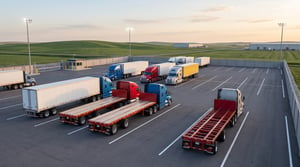
Finding safe, reliable parking isn't just an inconvenience—it’s a daily operational bottleneck. The shortage of secure truck parking directly hits your bottom line through stolen cargo, HOS violations, out-of-route miles, and driver burnout.
When high-value freight is forced onto shoulder ramps, unlit dirt lots, or unmonitored staging areas, risk spikes. To protect your assets and keep dispatches running on schedule, investing in modern fleet parking solutions is essential.
Not all truck parking networks offer the same baseline of security, tech, or geographic coverage. Here is what fleet managers and operations leaders should demand when evaluating nationwide truck parking providers—and how platforms like FinPark streamline the process.
Multi-Layered Physical Security
A chain-link fence isn't enough for high-value freight. A secure yard requires overlapping physical deterrents to deter unauthorized access:
High-Perimeter Fencing and Gates
A standard chain-link fence is rarely enough for high-value freight. Look for yards fortified with perimeter fencing (typically 6–8 feet minimum) topped with razor or barbed wire. Automated entry and exit gates equipped with keypads, RFID scanners, or barcode readers ensure that only authorized equipment enters the premises.
High-Intensity LED Lighting
Cargo thieves thrive in low-visibility environments. Secure yards require full-coverage, high-lumen LED lighting across all drive aisles, staging zones, and peripheral boundaries. Clear lighting deters crime and assists drivers during late-night maneuvering, reducing backing accidents and mirror damage.
On-Site Personnel and Controlled Access
While automated security handles digital logging, physical presence remains a primary deterrent. Premium sites offer 24/7 security guards, roving foot patrols, or gated check-in booths where guard personnel verify tractor/trailer numbers, seal integrity, and driver identification before granting access.
Advanced Digital Access and Surveillance
Physical barriers set the baseline, but intelligent digital surveillance elevates standard yards into true secure truck parking hubs. Modern fleet managers need digital visibility into yard activities even when assets are hundreds of miles away.
HD CCTV with AI Analytics
24/7 coverage equipped with License Plate Recognition (LPR) and Optical Character Recognition (OCR) for container tracking. AI analytics flag loitering or unauthorized pedestrian access automatically.
Automated Digital Gate Logs
Real-time logging of timestamps, tractor numbers, driver credentials, and trailer tags. Having instant digital audit trails simplifies insurance claims and internal reviews if an incident occurs.
Support for Drop-and-Hook Operations
Fleets running drop-and-hook operations require more than standard tractor-trailer combination stalls. Flexible trailer parking services are critical for managing power-only lanes, seasonal surges, and long-term storage requirements.
Parking Need Based On Fleet Operations
Short-Term Staging ➡️ Hourly / Overnight Holds ⌛
Drop-and-Hook Yards ➡️ Power-Only Linehaul Switching 🚚
Long-Term Storage ➡️ Seasonal Overstock & Asset Retention 🔄
Reinforced Yard Infrastructure
Loaded trailers exert massive point-load pressure on yard surfaces. Facilities designed for drop-and-hook operations must feature concrete dolly pads or reinforced asphalt to prevent trailers from sinking or tipping, particularly during high summer temperatures.
Flexible Access Models
Your parking network must support diverse operational flows:
- Short-Term Overnight Parking: Safe rest stops for linehaul drivers managing HOS limits.
- Drop-Trailer Staging: Secure staging for power-only driver switches and regional relay models.
- Long-Term Asset Storage: Secure storage for excess trailers, chassis, container chassis, or seasonal fleet surplus.
Real-Time Reservations & App Integration
Searching for available parking costs time, burns diesel, and increases driver stress. The American Transportation Research Institute (ATRI) consistently ranks truck parking among the top industry concerns, noting that drivers spend an average of 56 minutes per day looking for parking—time that directly eats into billable drive hours.
Guaranteed Spot Reservations
A modern parking network must allow dispatchers and drivers to reserve verified parking spaces in advance. Driving to a facility only to find the gate locked or the lot full causes HOS violations and forces drivers into unsafe shoulder parking
Driver App Usability
A streamlined mobile app allows drivers to view yard details, amenities, entry codes, and navigation guidance on the go. Centralized administrative portals enable dispatchers to handle billing, reserve spots in bulk, and manage asset placement across multiple regions from a single dashboard.
Strategic Network Density Across Key Corridors
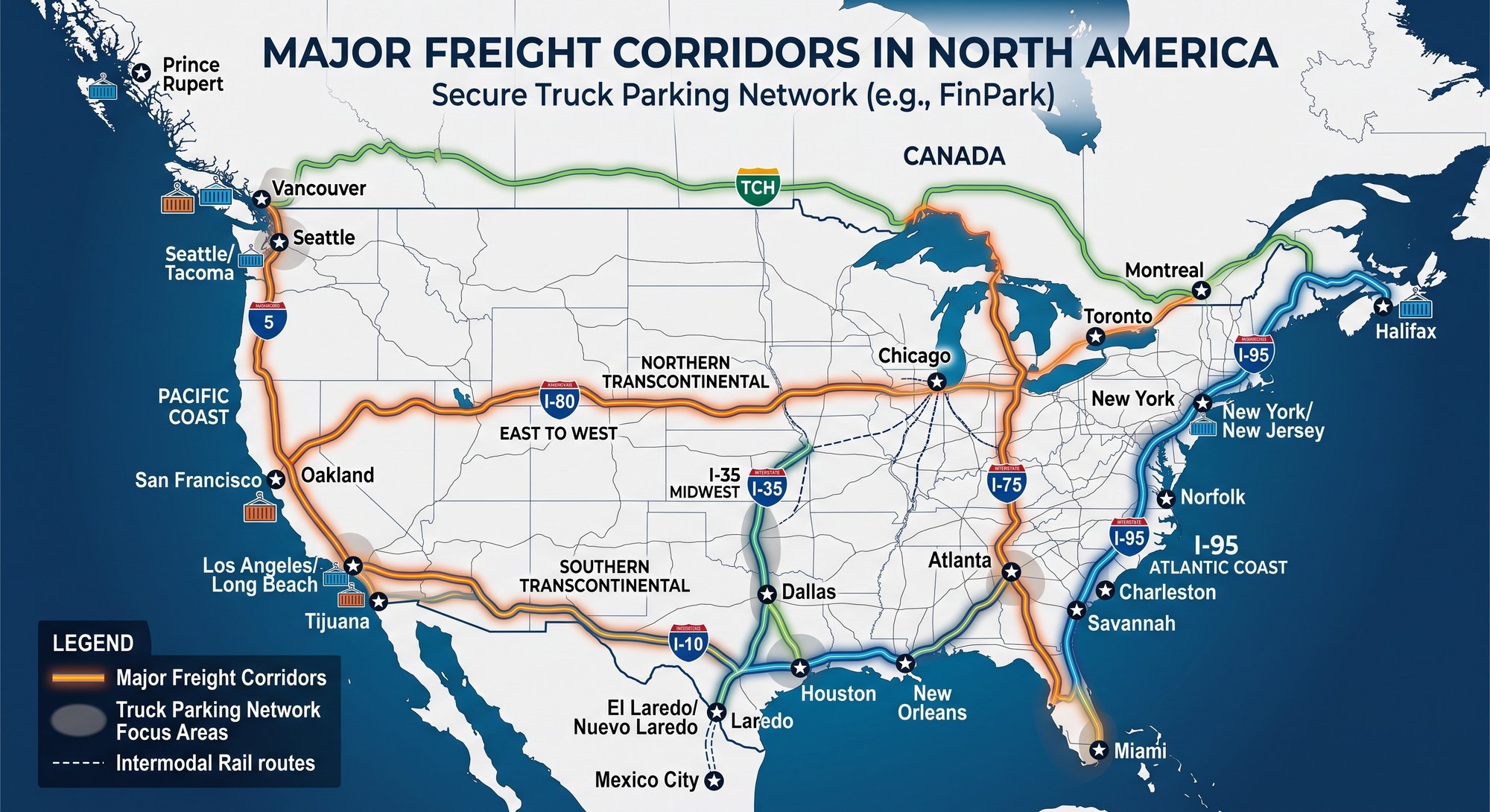
A single yard doesn't solve a national network problem. Look for parking density along major freight lanes, ocean ports, intermodal ramps, and border crossings.
Strategic Placement Near Major Logistics Hubs
An effective network places yards near critical freight lanes, intermodal ramps, ocean ports, and major distribution centers (such as I-95, I-10, I-80, and inland port hubs). Having yards positioned within 10 to 15 miles of primary delivery nodes minimizes empty miles and optimizes staging timing.
Cross-Border Capabilities
For carriers operating across North America, cross-border freight lanes (such as Laredo, Detroit, or Pacific Northwest gateways) require specialized secure staging. Facilities near border crossings must offer enhanced perimeter security and flexible staging durations to accommodate customs delays or drayage handoffs.
Driver Amenities That Support Retention
Secure parking isn't just about protecting the truck—it's about protecting the driver. Rest quality directly impacts road safety and driver retention. A quality network provides parking locations with the following types of amenities:
🚿 Personal Well-Being ➡️ Clean, private restrooms and showers.
📶 Connectivity ➡️ High-speed Wi-Fi for ELD updates and personal use.
🛏️ Rest & Refreshment ➡️ Well-lit break areas and food options.
🚚 Vehicle Care ➡️ Reefer shore-power plug-ins to cut idling noise and fuel burn.
How FinPark Simplifies Fleet Parking
FinPark eliminates the friction of parking management by uniting fleets, drivers, and secure yard operators under one technology platform:
- Instant Real-Time Booking: Reserve and pay for vetted spots on the fly to eliminate search time.
- Vetted High-Security Network: Every location is screened for physical security and infrastructure compliance.
- Multi-Asset Support: Staging for standard OTR setups, power-only drop trailers, ocean containers, and box trucks.
- Centralized Dispatch Control: Single-dashboard oversight with transparent pricing and consolidated, paperless billing.
Key Questions to Ask Before Choosing a Parking Partner
Before signing with a parking provider, ask:
- Are access gates fully automated with digital timestamping?
- Is 24/7 HD video footage archived and accessible for audit claims?
- Can dispatch reserve spots in advance directly from the office?
- Are drop zones built on concrete dolly pads?
- Does the platform integrate cleanly into your existing dispatch workflow?
Upgrade Your Parking Strategy
Treating truck parking as a strategic asset—rather than an afterthought—protects your cargo, keeps drivers safe, and secures your bottom line. Partnering with a tech-driven network like FinPark gives your operations team full control over fleet staging across North America.