

.jpg?width=300&name=What%20Causes%20Trailer%20Parking%20Access%20Problems%20A%20Deep%20Dive%20for%20Fleet%20Leaders_Banner%20(1).jpg)
For small and mid-sized fleet managers, the phrase "no parking available" isn't just an inconvenience—it is a direct drain on profitability. Every day, dispatchers and drivers work through a high-stakes puzzle trying to coordinate drops, hooks, and mandatory rest periods. Yet, finding reliable trailer parking access remains one of the most frustrating logistics challenges in modern trucking operations.
When a driver cannot access a secure yard, the ripple effects slam your bottom line. Equipment gets stuck, drivers burn legal hours searching for space, and customers experience supply chain disruptions.
To fix this problem in your fleet, you first have to understand what is causing it. This guide breaks down the hidden structural, economic, and operational root causes behind unreliable parking facilities, details how they impact your business, and highlights how smart technologies like FinPark are rewriting the rules of asset storage.
1. The Macro Problem: Structural and Economic Root Causes
The modern trailer parking crisis didn't happen overnight. It is the result of a decades-long mismatch between industrial growth and real estate development. For small and mid-sized fleets, understanding these macro pressures is the first step toward building a resilient logistics strategy.
The Real Estate and Zoning Bottleneck
The explosive growth of e-commerce has dramatically increased the demand for warehouse and distribution space. However, industrial zoning laws have failed to keep pace. Municipalities frequently approve the construction of massive million-square-foot fulfillment centers while heavily restricting or outright banning the development of dedicated truck and trailer parking lots nearby.
Local communities often lobby against truck yards due to concerns over traffic congestion, noise, and emissions. This "Not In My Backyard" (NIMBY) sentiment means that even when a developer wants to build long-term truck parking facilities near major freight corridors, they face years of bureaucratic red tape and zoning denials.
Skyrocketing Industrial Land Values
In major freight hubs like the Inland Empire in California, Northern New Jersey, Atlanta, Dallas-Fort Worth, and Chicago, industrial land values have reached historic highs.
When land becomes that expensive, real estate developers prioritize high-density warehousing over open gravel or asphalt lots. A warehouse yields a much higher return on investment per square foot than an open-air trailer yard. Consequently, existing parking facilities are regularly bought out, torn down, and replaced by buildings, shrinking the total supply of available asphalt.
The Asymmetry of the "Drop-and-Hook" Model
Shippers and receivers have increasingly shifted toward drop-and-hook operations to maximize their own dock efficiency. While this keeps freight moving faster through the warehouse door, it shifts the burden of asset storage entirely onto the carrier.
Fleets are forced to leave trailers at shipper facilities for days on end, while simultaneously needing local, off-site staging yards to store inbound trailers waiting for an open dock window. Because shippers rarely provide excess staging space, fleets are left scrambling to secure independent regional space, driving up localized demand to a breaking point.
2. The Micro Problem: Technology and Operational Visibility Gaps
While real estate scarcity sets the stage, it is a widespread lack of technology that turns a tight market into an operational nightmare. The physical parking spots often exist, but finding and securing them in real time is incredibly inefficient.
The "Analog" Yard Blind Spot
A shocking percentage of commercial truck parking lots, industrial yards, and independent storage facilities still operate using pen and paper, basic spreadsheets, or completely unmonitored gates.
Because these yards lack digital check-in systems or real-time space tracking, fleet dispatchers have zero visibility into actual space availability. A fleet leader cannot simply look at a screen to see if a facility fifty miles away has three open slots for dry vans; instead, they have to rely on guesswork, outdated phone calls, or sending a driver to investigate manually.
Fragmented, Siloed Property Ownership
The independent truck parking landscape is highly fragmented. Spaces are scattered across thousands of mom-and-pop lots, truck repair shops, towing yards, and industrial land owners who happen to have extra space.
Because there is no centralized directory or single booking protocol, a small fleet manager would have to negotiate separate contracts, insurance verifications, and payment terms with dozens of individual lot operators across a single lane. This administrative friction makes it nearly impossible for small to mid-sized fleets to remain agile when freight volumes shift.
Static Route Planning vs. Dynamic Realities
Traditional route-planning software assumes a perfect world where a driver rolls into a customer location, unloads, and immediately finds a safe place to park nearby. It does not account for real-time yard closures, overbooked facilities, or sudden weather delays. When static plans collide with dynamic, real-world disruptions, drivers are forced to make desperate, last-minute decisions regarding where to drop their equipment.
3. The Downstream Impact on Trucking Operations
When your fleet runs into restricted or unreliable trailer parking access, the consequences instantly trigger a chain reaction across your entire company.
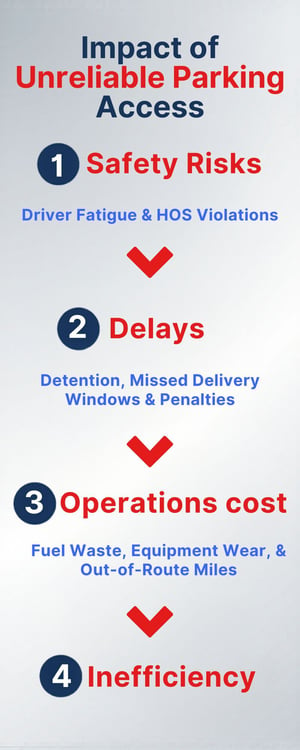
Safety and Compliance Risks
The lack of secure truck driver parking forces drivers into dangerous positions when their Hours of Service (HOS) clock runs down. If a driver cannot find or access a designated yard, they are frequently forced to park on highway shoulders, off-ramps, or abandoned commercial lots.
- Cargo Theft Exposure: Cargo thieves actively target unlit, unmonitored, and unsecured areas. Leaving a loaded trailer worth hundreds of thousands of dollars on the side of a highway or in a public lot exposes your fleet to catastrophic cargo theft and insurance claims.
- Driver Fatigue and Well-being: When drivers spend their final legal driving hours stressed out, searching for a place to park, it accelerates physical fatigue and mental burnout. A stressed, tired driver operating a 80,000-pound vehicle is an immediate safety liability on the highway.
- Regulatory Fines: Parking illegally on shoulders or ramps leaves fleets open to costly municipal citations, towing fees, and potential CSA (Compliance, Safety, Accountability) point deductions that damage your carrier safety rating.
Costly Delays and Supply Chain Disruptions
Unreliable access to staging and parking yards directly degrades your on-time delivery percentages, fracturing relationships with primary shippers.
- Missed Delivery Windows: If a trailer is parked 40 miles further away than planned because local yards were full, the driver may hit morning traffic or run out of HOS before they can complete the final mile deliverable.
- Driver Detention Chaos: When a receiver's yard is over-capacity and denies access to an arriving trailer, the driver must find an emergency layout spot. This triggers hours of uncompensated detention time, throwing off the driver’s schedule for the rest of the week and delaying subsequent loads booked for other customers.
Operating Inefficiencies That Drain Capital
For small and mid-sized operations, margins are thin. Inefficient parking access introduces unnecessary variable costs that quickly eat away at your profitability.
- Deadhead and Fuel Waste: Industry data indicates that drivers look for parking for an average of one hour per day. That hour translates to roughly 50 to 60 miles of unnecessary driving—commonly referred to as deadhead or out-of-route mileage. Multiplied across a fleet of 20 or 50 trucks, this results in thousands of dollars in wasted fuel and accelerated equipment wear every single month.
- Underutilized Assets: Trailers sitting in unoptimized, hard-to-access yards are effectively dead capital. If you cannot easily track, access, and cycle your trailers back into the freight pool, you are forced to buy or lease additional trailers to cover the same volume, artificially inflating your fixed overhead.
4. How FinPark Solves the Trailer Parking Access Crisis
To survive in a competitive market, small and mid-sized fleets cannot rely on old, reactive parking strategies. You need a solution that bridges the gap between available real estate and digital operations. This is exactly where FinPark steps in.
FinPark is an on-demand, cloud-based truck and trailer parking marketplace operating seamlessly across Canada and the United States. By combining an expansive network of physical infrastructure with an intuitive digital platform, FinPark acts as a centralized operational hub for fleets trying to navigate the parking crisis.
Real-Time Market Visibility and Guaranteed Reservations
FinPark eliminates the guesswork that plagues dispatchers and drivers. Through a clean mobile application or desktop web portal, your team can search, discover, and instantly reserve verified trailer parking spaces in real time.
Because listings include exact yard descriptions, live availability, and clear upfront pricing, you no longer have to send drivers into a region blind. A reservation through FinPark is a guaranteed spot, meaning your driver can navigate directly to the facility without burning legal HOS hours searching for parking.
Vetted, High-Security Facilities
You should never have to compromise on security to get a spot. FinPark’s risk management team actively reviews and monitors the locations within their network. Fleet managers can easily filter listings by critical safety infrastructure, including:
- 24/7/365 manned security or gated electronic access
- Continuous high-definition video surveillance and perimeter fencing
- Well-lit yards designed specifically to mitigate cargo theft
This ensures your high-value freight and trailers are protected, allowing your drivers to rest with genuine peace of mind.
Streamlined Administration for Small and Mid-Sized Fleets
Instead of managing multiple billing accounts, credit card authorizations, and individual insurance verifications for every different yard your trucks use, FinPark centralizes everything into a single, paperless transactional ecosystem.
Whether your fleet requires short-term emergency staging for an unexpected delay or long-term truck parking for asset storage during seasonal freight downturns, you can manage, track, and pay for all reservations through one centralized dashboard. This drastically reduces administrative overhead, allowing small fleet operations teams to punch well above their weight class.
5. Strategic Blueprint: How Fleet Managers Can Optimize Parking
Deploying technology like FinPark works best when paired with proactive internal operational habits. Small and mid-sized fleets can use this three-step blueprint to gain a competitive edge:
|
Action Pillar |
Implementation Strategy |
Core Objective |
|
Pre-Book Staging Along Dedicated Lanes |
Analyze historical lane data. Identify consistent bottlenecks and book parking spots 24-48 hours before the driver arrives in the destination metro area. |
Eliminate last-minute hunting and drastically reduce driver stress near destination hubs. |
|
Audit Real-Time HOS Utilization |
Train dispatchers to cross-reference a driver's remaining electronic logging device (ELD) hours with real-time yard availability via FinPark before assigning the final run of the day. |
Prevent forced, illegal shoulder parking and protect your carrier safety scores. |
|
Factor Staging Costs Into Customer Freight Rates |
Calculate the exact cost of local trailer staging and incorporate those fixed parking costs directly into your spot market or contract rate negotiations with difficult shippers. |
Protect your operating margins from being eroded by customer yard inefficiencies and detention. |
The Path Forward for Smart Fleets
Unreliable trailer parking access is a systemic challenge, but it does not have to break your business. By understanding the real estate and operational realities that drive the parking shortage, small and mid-sized fleet leaders can pivot away from reactive, stressful habits.
Leveraging modern, digital marketplaces like FinPark gives your operation the visibility, security, and flexibility required to keep equipment safe, drivers compliant, and freight moving on schedule. Stop letting parking guesswork dictate your profitability. Equip your team with the tools to find, reserve, and secure your fleet's space ahead of time.