

The Definitive Guide to Reducing Detention, Dwell Time, and HOS Compliance Risk
The North American trucking landscape in 2026 demands unparalleled operational agility. As diesel prices face volatile shifts and empty positioning miles continue to drain a fleet’s bottom line, asset utilization separates profitable operations from struggling ones. Today, tractor-to-trailer ratios frequently sit at 1:3 or higher, meaning a significant portion of a fleet's capital is sitting on wheels across the country.
To maximize these assets, carriers rely heavily on drop-and-hook trailer parking, a method that constitutes nearly 50% of the truckload market. In theory, dropping a loaded or empty trailer and immediately hooking onto another sounds like the ultimate operational shortcut.
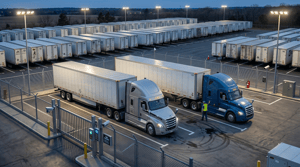
In practice, the success of this model hinges on strategic geography and asset security. If your staged trailers are buried in unorganized yards, parked far away from target shippers, or targeted by modern cargo theft syndicates, your operational efficiency vanishes.
For fleet managers and operations leaders at multi-state fleets, securing a reliable footprint of secure truck and trailer parking is no longer just a driver comfort issue—it is a core strategy for survival. This comprehensive, step-by-step guide explains how implementing secure, long-term drop-and-hook staging hubs can fundamentally transform your fleet metrics, protect your hours of service (HOS), and scale your network.
The Strategic Link: How Secure Staging Solves 3 Major Fleet Pain Points
Many operations leaders treat trailer parking as an afterthought, an administrative detail managed on the fly by dispatchers or drivers. In 2026, viewing parking through this narrow lens is a costly mistake.
Where you place your unattached trailers directly dictates your line-haul efficiency, driver retention, and legal compliance. Here is a breakdown of how strategic trailer placement targets the three biggest vulnerabilities in multi-state fleet operations.
1. Eliminating Shipper Detention and Reducing Dwell Time
Shipper facilities are notorious bottlenecks. Live loading and unloading can drain hours from a driver’s day, forcing tractors to idle and wait on warehouse staff. While transitioning to a drop-and-hook model is meant to bypass this issue, relying entirely on a shipper's on-site yard causes unique problems. Shippers face their own congestion backlogs, often burying drop pools behind other equipment or forcing carriers to move their unattached assets off-site due to overcrowding.
By utilizing dedicated, off-site long-term truck parking solutions, fleets establish independent micro-hubs right outside heavy freight corridors. Instead of waiting for a shipper’s gate to clear, drivers drop their incoming trailers at a nearby, organized drop lot and hook onto a pre-staged asset.
This infrastructure decouples the tractor from the shipper’s internal delays. The result is a sharp drop in facility dwell time and a structural method for reducing detention and dwell time across your entire multi-state network.
2. Mitigating Hours of Service (HOS) Compliance Risk
The search for safe, legal parking wastes an average of one hour of driving time per day per driver. When a driver enters a major industrial market without a guaranteed parking spot, they are forced to make a dangerous calculation: cut their driving shift short to claim an available space, or push past their ELD limits searching for a spot, incurring costly HOS violations.
When your fleet integrates dedicated drop-and-hook parking spaces into its route planning, this guesswork is eliminated. Drivers know exactly where their next asset is staged and where they can safely park their tractor when their clock runs down. Protecting the driver's clock ensures fleet efficiency and compliance, keeping your safety scores intact and preventing your equipment from becoming stranded on highway shoulders or hazardous off-ramps.
3. Cutting Empty Repositioning and Deadhead Miles
According to industry benchmarks, empty miles account for roughly 16.7% of all truck movements. With average truck operating costs hovering above $2.25 per mile, running an empty tractor even 100 miles out of route to retrieve a trailer can cost your business hundreds of dollars in direct operating expenses, driver wages, and wasted fuel.
When a trailer pool drifts out of balance due to seasonal spikes—such as produce season in the spring or the retail rush in autumn—fleets without a structured geographic footprint are hit with massive repositioning fees. Establishing permanent, secure trailer parking positions within your core freight lanes ensures your equipment remains close to the freight source. This cuts down on deadhead miles, maximizes revenue-generating miles, and guarantees your trailers are positioned where they are needed most.
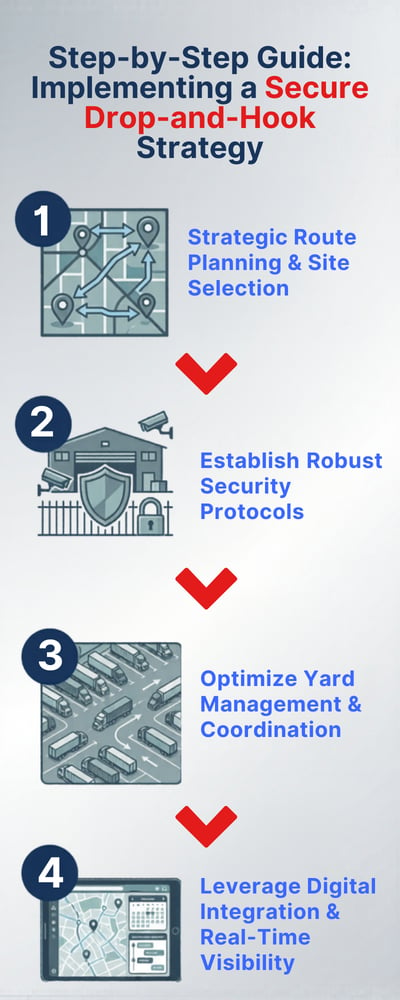
Step-by-Step Guide: Implementing a Secure Drop-and-Hook Strategy
Transitioning from an ad hoc, reactive parking model to an optimized, proactive staging strategy requires a methodical approach. Follow these four steps to build a scalable drop-and-hook trailer network for your fleet.
Step 1: Map Freight Corridors and Identify High-Dwell Hotspots
The first step is data collection. Fleet managers must audit their lane history from the past 12 to 24 months to identify exactly where operational friction occurs.
- Pinpoint the Bottlenecks: Analyze your ELD and telematics data to extract the average detention time at your top 20 shipper and receiver facilities. Look for regional clusters where drivers consistently burn through their HOS clocks waiting for access.
- Locate Asset Imbalances: Identify the geographic regions where your trailers sit idle for the longest periods. If your trailers are sitting unutilized in a specific metro area for weeks at a time, it signals a lack of regional staging options to quickly turn that equipment around.
- Establish Strategic Radii: Identify optimal zones for off-site staging yards, ideally within a 15-to-30-mile radius of your highest-volume shippers or major freight intersections (e.g., the Inland Empire, Chicago, Atlanta, or the I-95 corridor).
Step 2: Audit Facility Security and Mitigate Cargo Theft Risk
Dropping an unattached trailer means leaving an expensive asset—and potentially hundreds of thousands of dollars in cargo—unattended. Cargo theft losses exceed hundreds of millions of dollars annually across North America, with strategic theft syndicates specifically targeting staged, unattached trailers in transit hubs.
Before committing your assets to any long-term drop lot, your risk management team must rigorously evaluate the physical and digital security standards of the site. Use the following security checklist when assessing a yard:
|
Security Feature |
Minimum Acceptable Standard |
Fleet Benefit |
|
Perimeter Fencing |
6–8 foot chain-link with barbed/razor wire topping; anti-climb modifications. |
Prevents forced entry and opportunist intrusions. |
|
Access Control |
Electronic gates with individualized PIN codes, RFID scanning, or QR codes. |
Restricts entry to authorized personnel and creates a digital log of all arrivals and departures. |
|
Surveillance |
24/7 high-definition CCTV cameras with complete perimeter coverage and cloud storage. |
Provides continuous monitoring and clear evidence for insurance claims if an incident occurs. |
|
On-Site Staffing |
24/7 security personnel, physical guard checks, or active remote monitoring. |
Deters criminal activity and enables immediate response to breaches. |
|
Lighting |
High-intensity LED yard lighting covering all parking stalls and blind spots. |
Enhances camera visibility and discourages nighttime theft attempts. |
Step 3: Evaluate Nationwide Truck Parking Networks
Piecing together your staging footprint by negotiating individual leases with localized yard owners is an operational headache. It drains administrative resources, locks your fleet into rigid long-term contracts, and lacks the agility required to adapt to shifting freight demands.
To build a truly agile multi-state network, operations leaders should partner with nationwide truck parking networks that offer on-demand scalability. An ideal network partner should provide:
- Interstate Flexibility: Access to secure facilities across major logistical lanes, allowing you to quickly open up new staging pools when you win new shipper contracts.
- Variable Commitments: The option to secure spaces on an hourly, daily, weekly, or monthly basis, turning fixed real estate costs into a variable operational expense that scales up or down based on seasonal freight volumes.
- Verified Standards: A network that thoroughly vets its partner yards, ensuring that every listed location meets strict transparency, safety, and risk management criteria.
Step 4: Integrate Asset Visibility and Centralized Booking Tools
Infrastructure is only as effective as the software used to manage it. To run a seamless drop-and-hook operation, your dispatchers and drivers need real-time clarity into where spaces are booked, which trailers are parked in which stalls, and how to access the yard without friction.
Integrating your transportation management systems (TMS) with a digital parking marketplace ensures your dispatch team can locate and book safe parking instantly. This keeps your logistics pipeline clear, eliminates communication errors between drivers and dispatchers, and ensures that no asset is ever unaccounted for.
FinPark: The Smart Solution for Modern Fleet Logistics
Building a nationwide network of secure staging locations from scratch can feel like an overwhelming task. This is where FinPark comes in as an essential tool for modern fleet logistics.
As a premier cloud-based, on-demand truck parking marketplace, FinPark offers a comprehensive solution for carriers looking to streamline their drop-and-hook operations across both the United States and Canada. Backed by a deep expertise in logistics and transportation infrastructure, FinPark bridges the gap between private yard operators and fleets in need of reliable parking space.
Why Leading Fleets Rely on FinPark for Drop-and-Hook Operations:
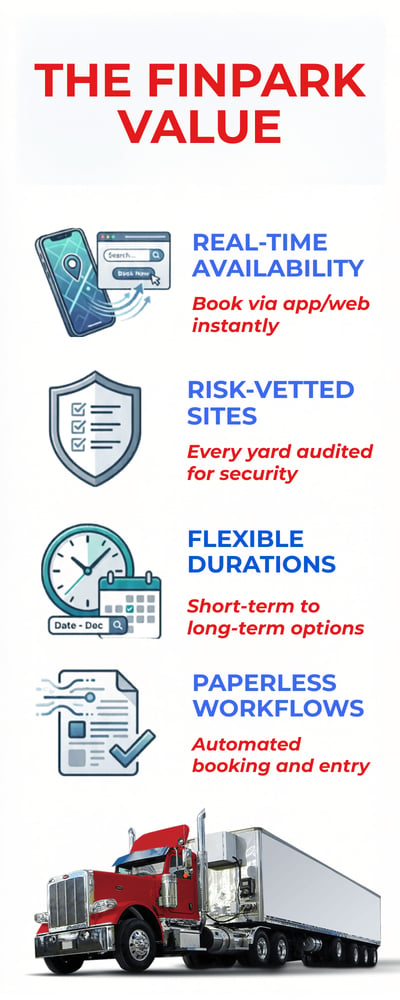
- Real-Time Booking and Predictive Visibility: FinPark enables dispatchers and drivers to search, reserve, and pay for guaranteed parking spaces in real time via an intuitive mobile app or desktop portal. Its predictive lane routing helps fleets secure spaces well before an asset arrives at its destination, avoiding late-night scrambles and HOS violations.
- Rigorous Risk Management: Security is a core priority for FinPark. Every single facility listed on the marketplace is carefully audited by their risk management team. This ensures that when you drop a trailer at a FinPark location, your cargo is protected by verified security measures, giving your operations team complete peace of mind.
- Operational Flexibility Without Fixed Overhead: FinPark eliminates the need for restrictive, long-term commercial leases. Whether your fleet needs overnight tractor parking, weekly drop slots for a seasonal project, or permanent monthly space for a high-volume trailer pool, the marketplace adapts to your needs. This allows you to scale your geographic footprint dynamically as your freight lanes shift.
- Frictionless, Paperless Operations: From automated digital payments to clear, transparent yard descriptions and entry instructions, FinPark removes administrative roadblocks. Drivers can quickly enter and exit staging yards without dealing with messy paperwork, saving valuable time and keeping your fleet moving efficiently.
By saving drivers an average of one hour of search time per day, FinPark directly translates into improved driver satisfaction, lowered operational costs, and optimized asset utilization.
Conclusion: Securing Your Fleet’s Competitive Edge
The transportation landscape demands that every asset perform at its peak efficiency. Relying on outdated, reactive approaches to trailer storage and driver routing is a fast track to inflated operating costs, severe shipper detention, and frustrated drivers.
By taking control of your staging infrastructure and investing in secure truck and trailer parking, your fleet can turn asset management into a distinct competitive advantage. Establishing strategic drop-and-hook staging hubs keeps your drivers moving, reduces facility dwell time, protects your HOS compliance scores, and lowers empty repositioning miles.
Don't wait for your trailers to get trapped in crowded shipper yards or stranded by the side of the highway. Partner with a scalable, reliable provider like FinPark to build your flexible, secure, and nationwide trailer parking network today.